

SAP EWM support and managed services (often called application management services, or AMS) usually cover incident handling, break-fix repairs, minor enhancements and monitoring, measured by response and resolution times. They rarely cover process performance. A site can meet every SLA while pick rates, dock-to-stock time and user confidence slide.
If you run SAP Extended Warehouse Management (EWM), the system that directs receiving, putaway, picking and dispatch in a distribution centre, you almost certainly pay for support of some kind. For most Australian enterprises that means an AMS contract with an integrator or SAP partner. It keeps the system running, and that job matters.
The problem is what the contract does not measure. This guide is for DC managers, supply chain executives and IT leads who sign for outcomes, not for SAP specialists. It explains what support normally includes, why a live site can look healthy on paper while the floor struggles, what to ask your provider, and where an independent view fits. Luminar is an independent SAP EWM consultancy. We do not sell managed services, software or the build, so this is a buyer's guide, not a service pitch.
Key Takeaways
- Standard EWM support and AMS contracts are built around tickets: incidents, break-fix, small enhancements and response and resolution times.
- SLAs measure support activity. They do not measure pick rates, dock-to-stock time or whether users trust the system.
- Drift is gradual. Workarounds, manual overrides, stale slotting and skipped RF steps build up quietly and rarely raise a ticket.
- Problems appear on the warehouse floor first, because EWM depends on ERP, connected modules and handheld devices working together.
- Ask your provider who owns process performance, who reviews configuration against how the floor works, and how outcomes are reported.
- An independent health check sits alongside your AMS provider. It adds an outside view of performance and does not replace the team keeping the system live.
Summary Table: Support Contract Versus Operational Performance
| Area | What a typical support contract covers | What it often misses | Who can close the gap |
|---|---|---|---|
| Incidents and faults | Logging, triage, break-fix, response and resolution times | Repeat causes behind similar faults | Support provider with a root-cause remit |
| Enhancements | Small configuration changes within an agreed allowance | Whether the change makes the floor task simpler | Business owner with an independent review |
| Configuration | Keeping settings stable and documented | Whether settings still match how operators work | Independent health check |
| Slotting and putaway | Usually out of scope or reactive | Stale bin logic as ranges and volumes change | Operations plus a process review |
| RF and handheld screens | Fixing defects | Extra scans, skipped steps and user confidence | Floor observation with operators |
| Reporting | Ticket volumes and SLA compliance | Pick rates, dock-to-stock time, error and rework trends | Operational KPI ownership inside the business |
What do SAP EWM support and managed services usually include?
A typical SAP EWM support contract covers incident handling, break-fix, a small allowance for minor enhancements, and SLAs measured on response and resolution times. It is built to keep the system running and tickets moving. It is not built to improve how the warehouse performs, unless that is written into scope. Choosing the support model before the integrator rolls off is its own decision, set out in who owns EWM in year two.
Most contracts follow the same service-management logic. Standards such as ISO/IEC 20000-1 and the ITIL framework organise support around incidents, problems, changes and service levels. That logic works well for keeping a system stable. It says very little about whether the physical operation is getting faster or more accurate.
The usual inclusions
Here is what you can normally expect to see in a scope document, with the jargon explained:
- Incident handling: a user reports something broken, the provider logs a ticket, assigns a priority and works it.
- Break-fix: repairing a defect so the system returns to its previous working state. Note the phrase: previous state, not better state.
- Minor enhancements: small configuration changes, often capped at an agreed number of hours per month.
- Monitoring: watching interfaces (the data links between EWM and other systems), background jobs and error queues.
- Technical upkeep: applying patches, supporting upgrades and keeping the SAP platform healthy.
- SLAs (service level agreements): targets for how fast the provider responds to and resolves each priority of ticket.
The usual exclusions
The gaps matter more than the inclusions. Process redesign, slotting reviews (deciding which bin each product lives in), floor observation, user retraining and major change requests are commonly out of scope or charged separately. Nothing here is a flaw in the provider. They deliver what was scoped. The risk sits with the buyer who assumes support means performance.
Why can a site meet every SLA while its KPIs slide?
Because SLAs measure the support team's activity, not the warehouse's results. A ticket closed inside its target time counts as a win even if the fix was a workaround that adds a scan. Each workaround is small. Together they slow the floor, and no contract metric records it.
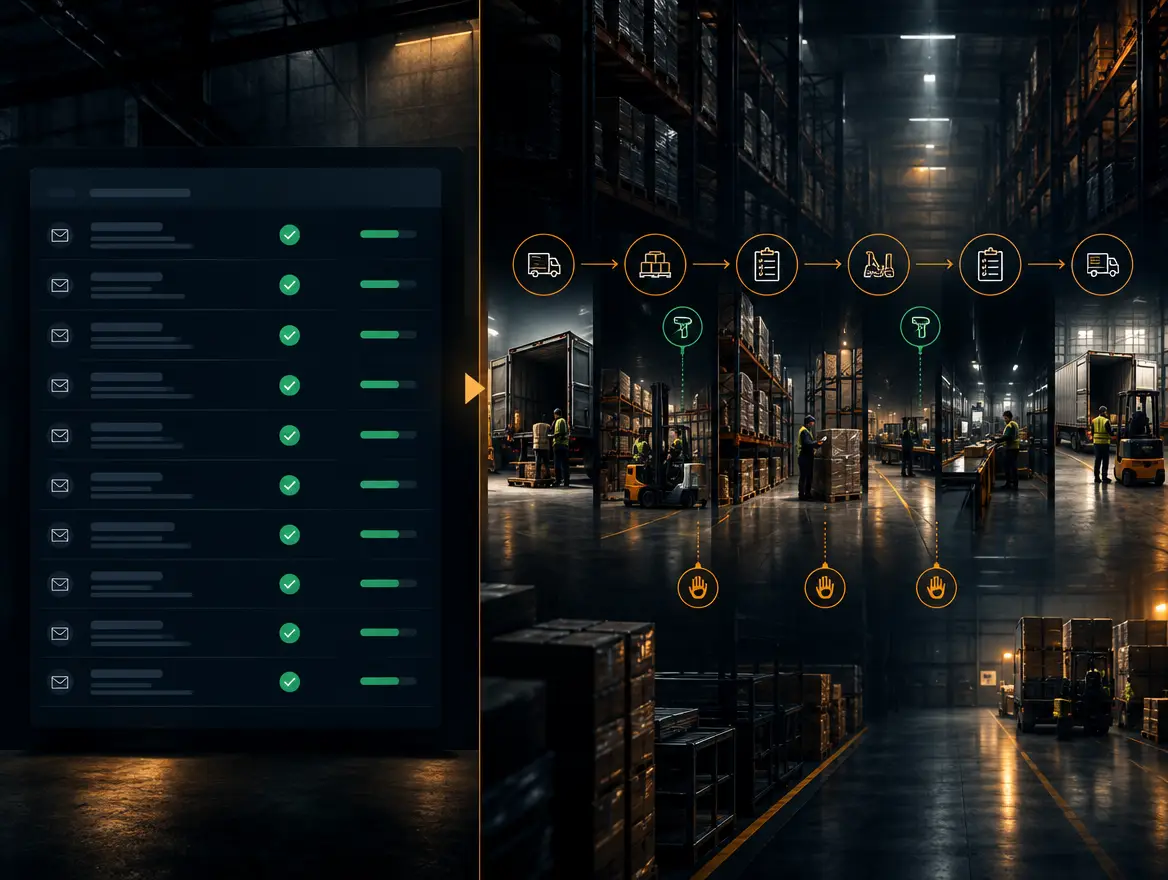
The gap is structural. A support provider is rewarded for closing tickets quickly. A DC manager is judged on throughput, accuracy and cost per line. Those two scorecards can move in opposite directions for months before anyone connects them.
Illustrative drift patterns
The examples below are generic and illustrative, not drawn from a named client. They are the patterns we look for on live sites that feel off.
- Workarounds that become the process. Consider a putaway task that errors on an unusual pallet. The ticket is closed with a manual posting. Operators learn the manual route, and soon half the shift uses it.
- Manual overrides. Supervisors start overriding system-directed tasks because the system's choice no longer matches the floor. Each override is invisible in a ticket queue.
- Stale slotting. Product ranges, pack sizes and customer profiles change. Bin logic set at go-live does not. Fast movers end up far from dispatch.
- Skipped RF steps. RF means radio frequency, the handheld scanners operators use. Imagine a screen that asks for a confirmation scan the operator knows adds nothing. They skip it where the system allows, and stock accuracy erodes.
- Quiet exceptions. Damaged goods, mixed pallets and short deliveries are handled off-system, then reconciled later by someone in an office.
This is what we call System Vs Reality. The system expects operators to follow steps in sequence, for example unpack, inspect, then putaway. Reality is that workers combine steps, skip exceptions and meet handling units (the pallet or carton with its own ID) that the design never anticipated. When exception handling on the RF screen is not intuitive, people abandon the system's path and invent their own.
Why do EWM problems show up on the floor before they reach a ticket?
Operators adapt before they complain. When an EWM step is slow or unclear, they work around it, and the problem only reaches a ticket when the workaround fails. Because EWM sits between ERP, connected modules and handheld devices, the symptom often appears far from its cause.
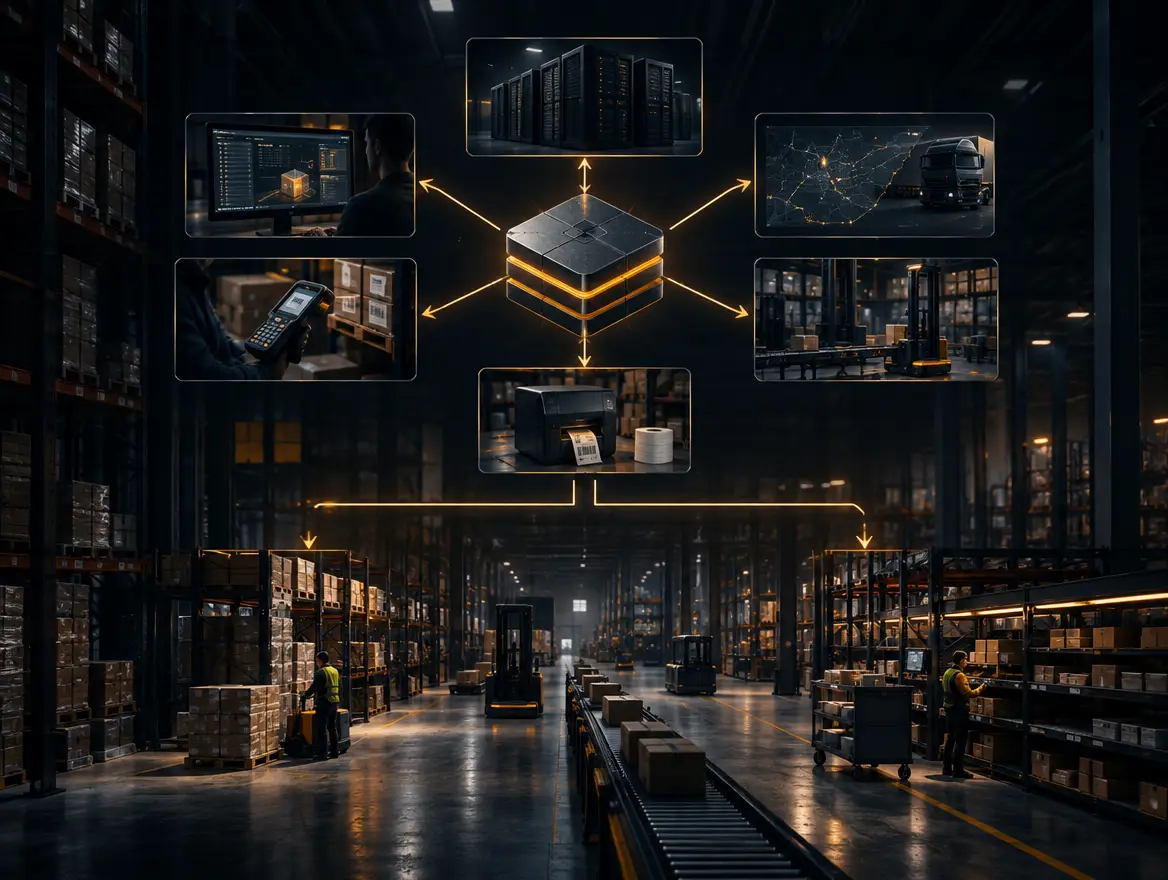
EWM does not run alone. Your ERP (the core SAP system holding orders, deliveries, inventory and finance) feeds it deliveries and receives stock movements back. Depending on your site, transport planning, labour management, automation and label printing also connect in. A delay or data error in any link shows up at the dock door or the pick face.
Consider a simple case. An inbound delivery reaches the ERP late or with the wrong pack data. EWM cannot direct putaway cleanly. The operator stands at the dock with a pallet and a screen that will not proceed. Nobody raises a ticket for the first few occasions. They find a way through, and the way through becomes habit.
Where user confidence comes from
Our view, shaped by more than 15 years across SAP WM and EWM programmes, is that user confidence comes from two things: ease of use and predictability. If a task takes the same steps every time and the screen behaves as expected, operators trust it. If steps change with no reason or exceptions need a call to a supervisor, they stop trusting it.
This is why we say a good approach is User focused rather than System Focused. Every system action has a physical movement behind it. A forklift travels, a person walks, a pallet is lifted. Each extra scan or screen step multiplies across every operator, every shift and every day. That is where labour cost and complexity compound, and large integrators running big programmes often lose sight of it.
There is a plain test. Ask a shift supervisor which steps operators skip, and which tasks they do outside the system. If they answer quickly, the drift is already there.
What should you ask your current SAP EWM support provider?
Ask three things: who owns process performance, who reviews configuration against how the floor actually works, and how outcomes are reported. If the answers are "the business", "nobody" and "ticket volumes", your contract is working as written and still leaving you exposed.
These questions are not an accusation. They surface what the contract does and does not promise, which is information you need before renewal or before KPIs slip further.
Who owns process performance?
Ask for a name. If the provider owns system stability and your operations team owns the floor, then nobody owns the point where the two meet. That seam is where drift lives. Agree who is accountable for pick rate, dock-to-stock time and error rates, and who can request a configuration change when they move.
Who reviews configuration against how the floor works?
Configuration is the set of rules telling EWM how to direct work. It was designed for the operation as it stood at go-live. Ask when it was last compared with the live process, who did it, and whether anyone stood on the floor with operators to do so. A desk review of settings will not find a skipped RF step.
How are outcomes reported?
Request the last three monthly reports. Look for operational measures, not only ticket counts and SLA compliance. Useful questions include:
- Are repeat incidents tracked, and are root causes fixed or only the symptom?
- Is there a log of manual overrides or off-system tasks?
- How do enhancement requests get prioritised, and does anyone check they made the floor task simpler?
- What does the provider say about user feedback, and how is it collected?
What is outside the contract?
Ask for the exclusions in plain language. Slotting reviews, training refreshers, process redesign and interface changes are the items that most often fall between scopes and quietly decay.
When does an independent SAP EWM health check make sense?
An independent SAP EWM health check makes sense when KPIs have slid, workarounds have multiplied, users have lost trust, or a support contract has run for years without a review of how the floor works. It sits alongside your AMS provider, adding an outside view of process performance rather than replacing the team that keeps the system running.
A SAP EWM health check looks at whether the live system still fits the live operation. That is different from technical performance tuning, which looks at system response times and background jobs. Both have value. For most buyers sensing drift, the process view is the missing one.
Common triggers
- Throughput or accuracy has slipped and nobody can say why.
- Supervisors report more overrides, paper lists or spreadsheets beside the system.
- A new product range, customer or channel has landed on a layout designed for something else.
- A group template has been rolled out and local reality does not quite fit it.
- Your support contract is approaching renewal and you want to scope it on evidence.
- Peak season is coming and you want to know what will break under load.
How it works with your AMS provider
The aim is not to replace your support team. They know your landscape, your interfaces and your history. An independent consultant brings a different question: is the system helping the floor? Findings come back as a prioritised list that your AMS provider can action under existing or revised scope.
Independence matters here. A consultant who sells the build or the software has an interest in what the review finds. Luminar sells neither, so the memo is not a route to a larger engagement. If you want an independent SAP EWM consultant to challenge your current arrangement, that separation is the point.
What does a Luminar Floor Audit involve?
A Luminar Floor Audit is one day on site with a senior consultant, followed by a plain-language memo within five working days. It is complimentary and has no proposal attached. Luminar does not sell software or the build, so the memo reports what we see, not what we could sell.
The day is spent where the work happens. The consultant walks the flow from receiving through putaway, picking, replenishment and dispatch, watches operators use the handhelds, and talks with supervisors about the tasks that go wrong. What we see on the floor is then compared with how the system is configured to behave.
The memo is written for a buyer, not a SAP specialist. It covers what is working, where the system and the floor have drifted apart, and what to address first. There is no jargon-heavy report and no sales deck behind it. You can hand it to your AMS provider, your IT team or your leadership and each will understand it.
If you are not ready to bring someone on site, a 30 minute advisory call is the lighter option. It is a conversation about your symptoms and whether an on-site look would be worth your time.
Next step: book a complimentary Floor Audit, or book a 30 minute advisory call if you would rather talk first.
Original Insight: Why Outcome-Focused Buyers Get More From EWM
Outcome-focused customers get more value from SAP EWM by turning execution into measurable operational performance. That means agreeing what good looks like on the floor, measuring it, and holding someone accountable for it. A support contract alone will not do that, because it measures tickets, not the warehouse.
This is a contrarian position, and I hold it deliberately. Many programmes are run to a timetable and a budget. Operations are asked to change before they are properly set up and enabled to do so. Blindly progressing through implementation phases weakens how well stakeholders absorb the solution, lowers solution quality and widens the gaps between design and practice. Being Outcome rather than Budget focused reverses that order.
What this looks like in practice is visible in our own project work. The author of this guide, Johan Bruwer, Managing Partner and Principal Consultant at Luminar, has more than 15 years across SAP WM and EWM programmes. Luminar's own record is 100% on-time and in-budget delivery across 3 projects in 12 months (Luminar's own data). That record comes from enabling operations before go-live, not from pushing a date.
Here is one first-hand example. A Brisbane-based plasterboard manufacturer and distributor moved from a non-warehouse-management base, which meant delayed inventory updates, stock inaccuracies and slow reconciliation between manufacturing and the physical warehouse, onto its group's own EWM template. Luminar was brought in as the local link between the overseas build team and Australian operations. The role grew from change management and operational readiness to full project responsibility.
We built solutions in standard EWM functionality for goods receipt from manufacturing and for shipping. Those solutions simplified the Australian rollout and were later adopted into the group's global template. We trained key users on real scenarios with practical fault-finding so knowledge passed to the wider user base with confidence. We configured the handhelds and scanners to keep data entry simple, and we kept error resolution fast through UAT (user acceptance testing) and go-live.
The outcome was a clean transition from the legacy system. The site handled outbound volumes up to 30% higher on some days with no additional overtime. With few system errors, the team moved to small improvements in the second week after go-live. Operational management reported better traceability and fewer loading errors and stock differences. The group's process owners called it the most successful rollout to that point. Subcontract drivers also noticed, having seen a competitor's rollout go badly at the loading dock.
Two points apply to a live site. First, the support intensity that made that go-live work was project delivery, not a run contract, and Luminar does not sell managed services. Second, the lesson carries over: confidence stays high when errors are fixed quickly and the system matches how people work. A live site that has drifted needs the same attention, measured against floor outcomes. Then, as a status report might put it, the implementation is still on track in a way that matters to the person running the dock.
References
- SAP, Extended Warehouse Management documentation on the SAP Help Portal
- SAP, SAP Extended Warehouse Management product overview
- ISO, ISO/IEC 20000-1:2018 Information technology: Service management system requirements
One day on your floor, a plain-language memo in five working days.
A senior SAP EWM consultant watches the busy window, reads the system alongside it and tells you what is costing taps, seconds and dollars. No proposal attached.