

The right SAP EWM implementation partner in Australia is one that has run warehouse floors, not just delivered documents. Test who will be on site, how senior the delivery team is, whether references are comparable Australian DCs, and whether the partner will commit to operational KPIs such as throughput, accuracy, dock-to-stock and user adoption.
Most buyers compare SAP EWM partners on methodology decks, deliverable lists and rate cards. Those documents look alike across vendors. They do not tell you whether the partner understands what happens when a picker meets a new RF screen at 5am with a trailer waiting.
This guide is written from Luminar's independent position. We sell no software and we do not sell the build. You will get a way to match a partner to your scenario, questions that expose real floor experience, red flags to watch for in proposals, and a method for tying the contract to operational KPIs. It is written for executives, DC managers and IT leads who sign for the outcome and are not SAP specialists.
Key Takeaways
- Partner selection shapes the result more than the software does, because EWM is highly configurable and every design choice lands on the warehouse floor.
- Match the partner to your scenario: greenfield, WM to EWM, group template landing, or live-site recovery each need different strengths.
- Ask who will physically be on site, for how long, and how senior they are. Then speak to operations leaders at comparable Australian DCs.
- Treat artefact-heavy scope, junior-heavy staffing, vague KPIs and missing adoption or hypercare plans as red flags.
- Agree operational KPIs and baselines before you sign, and link acceptance to them rather than to document delivery.
- An independent senior adviser works alongside any integrator as a check on scope, design and readiness.
Summary Table: Matching Partner Strengths to Your Scenario
| Scenario | What the partner must prove | Main risk if they cannot | First thing to test |
|---|---|---|---|
| Greenfield DC build | Design judgement for a site with no legacy habits | Over-engineered process that slows operators | How they design for the physical flow, not the system flow |
| Move off SAP WM to EWM | Respect for what already works on the floor | Lost local practice and a painful relearning curve | How they separate legacy workarounds from real requirements |
| Group template landing | Local translation of a global design | Template fits head office, not the Australian site | Who owns local fit and operational readiness |
| Live-site recovery | Diagnosis before change | Fixing symptoms and adding more scans and steps | How they measure the current site before proposing anything |
Why Partner Selection Decides the Outcome More Than the Software
Partner selection decides the outcome because SAP EWM is a flexible toolkit, not a fixed answer. Two partners can configure the same software and leave you with very different warehouses. The difference is how well they understand the physical work behind each system step, and how that work is experienced by the people doing it.
The flexibility is the risk
SAP EWM can model almost any warehouse process. That is its strength and its danger. Every putaway strategy, handling unit rule, exception path and RF screen is a choice. Someone has to make those choices well, and the right answer depends on how your operation actually moves product.
EWM also does not live alone. A goods receipt from manufacturing, for example, touches production confirmation, inventory valuation, delivery processing and quality checks in the wider SAP landscape. A partner who knows EWM in isolation will configure a warehouse that works in a test script. A partner who understands how EWM interacts with the surrounding SAP SCM modules builds one that works when the whole supply chain pushes on it.
Every system step is a physical movement
Our view, shaped by more than 15 years of SAP WM and EWM programmes led by Johan Bruwer, Managing Partner and Principal Consultant, is simple. For every system action there is a physical movement on the warehouse floor. That is where labour cost, complexity and disconnect compound. Each additional scan or confirmation step looks small on a design workshop slide. Multiplied across a shift, a site and a year, it becomes real cost and real frustration.
Large-scale integrator programmes often lose sight of this. The design is signed off in a conference room, far from the dock. The first time anyone asks how many taps it takes to put away a mixed pallet is during user acceptance testing, when it is expensive to change.
Timelines should serve readiness, not the reverse
Most implementations push to a fixed timeline and expect operations to adapt, whether or not people have been properly set up and enabled. We take the opposite position. Moving blindly through EWM implementation phases weakens how well stakeholders absorb the solution, reduces solution quality and raises the risk of gaps and misalignment.
A status report that says Implementation is still on Track against the plan tells you nothing about whether supervisors can run a shift on the new system. Good partners track both. Great partners will slow a phase gate when readiness is not there, and explain why in plain language.
How to Match an SAP EWM Partner to Your Scenario
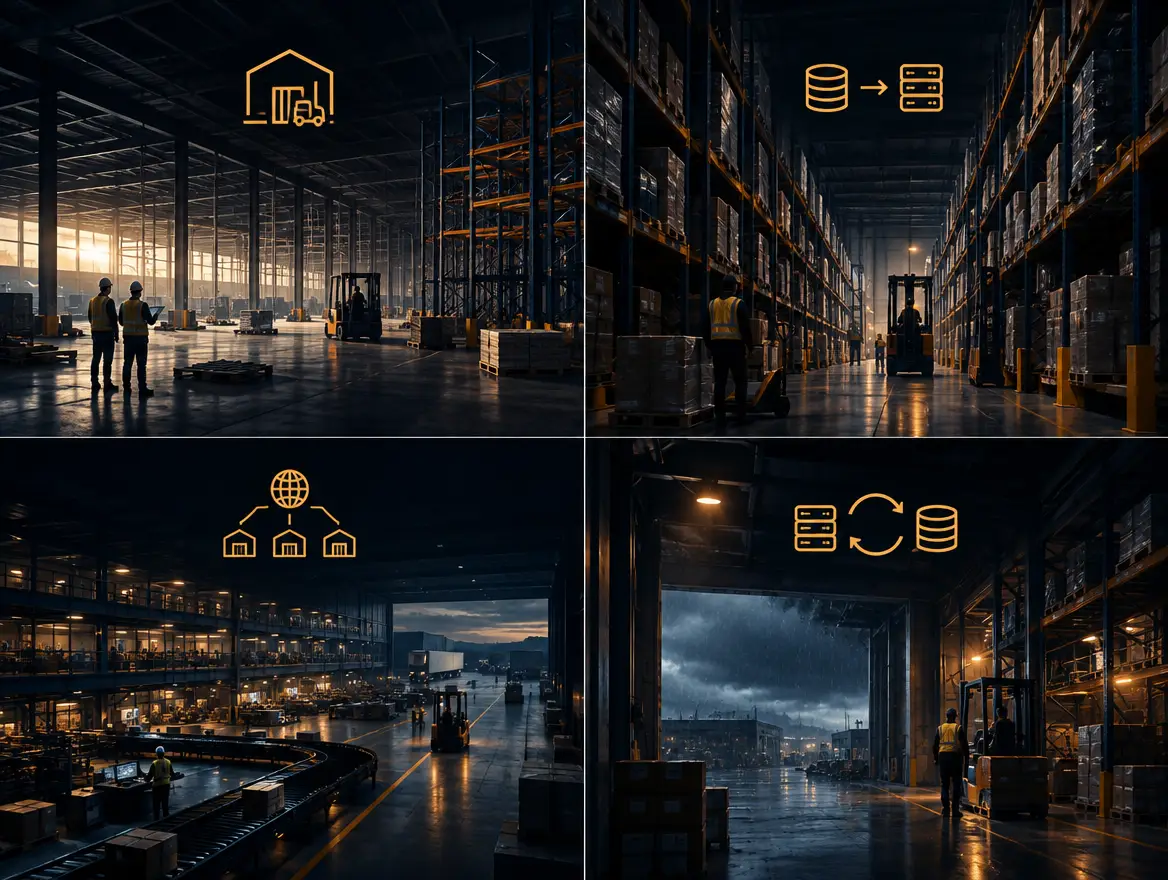
Match the partner to your scenario, because the four common EWM situations need different strengths. A greenfield build rewards design judgement. A WM migration rewards respect for existing practice. A template landing needs local translation. A live-site recovery needs diagnosis before any change. One generic methodology rarely covers all four well.
Greenfield DC build
A new distribution centre is the cleanest opportunity you will get. There are no legacy habits to carry over, and no excuses for a clumsy process. The risk is the opposite of a migration: a partner with a blank page can over-design.
Test how the partner designs from the physical flow outward. Ask them to walk you through inbound, putaway, replenishment, picking and dispatch for your product mix, including the unglamorous exceptions. If the conversation stays at the level of system objects and never reaches pallets, forklifts and dock doors, keep looking.
Moving off SAP WM to EWM
A move from WM to EWM is not a like-for-like upgrade. EWM is a different application with a different data model and process logic, so it cannot be treated as a technical conversion. Operators who have run WM for years carry knowledge and workarounds that deserve respect, and some deserve to be retired.
The partner you want can tell the two apart. Ask how they will capture what the floor actually does today, and how they will decide which practices to keep. Ask how they will train experienced WM users who are confident in the old system. Timing and scope questions tied to your S/4HANA path are covered in our related article on S/4HANA warehouse scope, so we will not repeat them here.
Group template landing on an Australian site
Global templates promise consistency. They also arrive with assumptions built for another market, another labour model and often another time zone. The job in Australia is local translation: keeping the template's integrity while fitting it to how your site really works.
The key question is who owns local fit and operational readiness. If the global build team owns configuration and nobody owns readiness on the ground, you have a gap. A strong in-country partner acts as the conduit between the global team and local operations, and is honest when the template needs adjusting. We describe one such programme in the original insight section below.
Live-site recovery
If your EWM site is live and KPIs are sliding, the temptation is to start fixing. Resist it. Drift usually has several causes: undocumented changes, workarounds that became standard practice, master data decay, and training that faded after go-live.
A good recovery partner measures first. They should be able to describe the current state of your site in plain language before proposing a single change. Be wary of any partner who arrives with a remediation plan before they have stood on your floor.
Questions That Expose Real Warehouse Floor Experience
Ask who will be on site, for how long, and how senior they are. Then ask for references from Australian DCs similar to yours, and speak to the operations manager, not the project sponsor. Partners with real floor experience answer these questions specifically. Partners without it answer with methodology.
| Question | What a strong answer sounds like | Warning sign |
|---|---|---|
| Who will be on site during design, testing and go-live? | Named people, with dates and roles | "The team will be allocated closer to the start" |
| How senior is the day-to-day delivery team? | Senior consultants do the design and the floor work | Seniors appear in the pitch, juniors do the build |
| Which comparable DCs have you delivered in Australia? | Specific sites, similar product and handling profile, reachable references | Generic global logos with no local contact |
| How do you test design against how operators really work? | Time on the floor, operator walk-throughs, scenario-based testing | Workshops with managers only |
| What happens in the first two weeks after go-live? | Named support, fast error resolution, daily floor presence | A ticketing queue |
Seniority and presence
The most useful question is also the simplest: who will I see on my site? Proposals often showcase partners and principals, then staff the project with consultants who have never run a shift. Ask for the CVs of the people who will do the work. Ask what proportion of time each will spend on site rather than remote. Ask what happens if a key person leaves mid-project.
References from comparable Australian DCs
A reference from a different industry or a very different site tells you little. A pharma cold chain DC and a building materials yard have little in common. Ask for references that match your handling units, your volume profile and your labour model, and call the operations lead who lives with the system every day.
For APAC buyers, add a regional test. Check where the proposed consultants are based, whether they have delivered in your country or only in Australia, and how site visits will work across time zones. An SAP EWM consultant in APAC who can be on your floor quickly is worth more than one with a better global brochure.
Ask how they validate design against reality
We use a simple lens we call System Vs Reality. The system expects operators to follow rigid sequential steps, such as unpack, quality inspection, then putaway, with no deviation. Reality is different. Workers combine steps, skip exceptions and meet unexpected handling units that break the expected sequence.
The design response is intuitive exception handling and RF screens that cope with human intuition. Overly complex setups lead workers to abandon the system, and abandonment is how inventory accuracy quietly collapses. Ask each partner how they test for this before go-live. A credible answer involves operators, real scenarios and fault-finding, not only test scripts.
Red Flags in SAP EWM Proposals
The main red flags in an SAP EWM proposal are artefact-heavy scope, junior-heavy staffing, vague KPIs, and no plan for user adoption or hypercare. Each one shifts risk from the partner to you. A proposal that lists documents but promises no operational result is asking you to pay for activity.
Artefact-heavy scope
Count the deliverables. If the scope is dozens of documents and a handful of operational outcomes, the partner is selling effort. Documents matter, but nobody has ever put a pallet away with a blueprint. Ask what each artefact changes on the floor. If the answer is nothing, question why you are paying for it.
Junior-heavy staffing
Look at the pyramid. A few senior names on top and a wide base of junior consultants below means your site becomes a training ground. Junior consultants can be excellent contributors when they are supervised on the floor by someone who has done it before. The red flag is when nobody senior is ever there.
Vague KPIs
Phrases like "improved visibility", "streamlined processes" and "best practice" cannot be measured. If the proposal does not name specific operational measures, baselines and targets, you cannot hold anyone to anything. We cover how to fix this in the next section.
No plan for user adoption or hypercare
A proposal that ends at go-live has ignored the hardest period. Look for a named training approach, key user preparation, floor support at go-live and a defined hypercare window with exit criteria. If hypercare is described as "as required" or priced as a separate optional extra, assume you will need it and negotiate now.
Phase gates without readiness tests
If the plan has gates for build complete and test complete but none for operations ready, the timeline is driving the project. Ask what happens if operations are not ready on the planned date. A partner who has never delayed anything on readiness grounds has probably never been honest about it.
How to Define Success as Operational KPIs Before You Sign
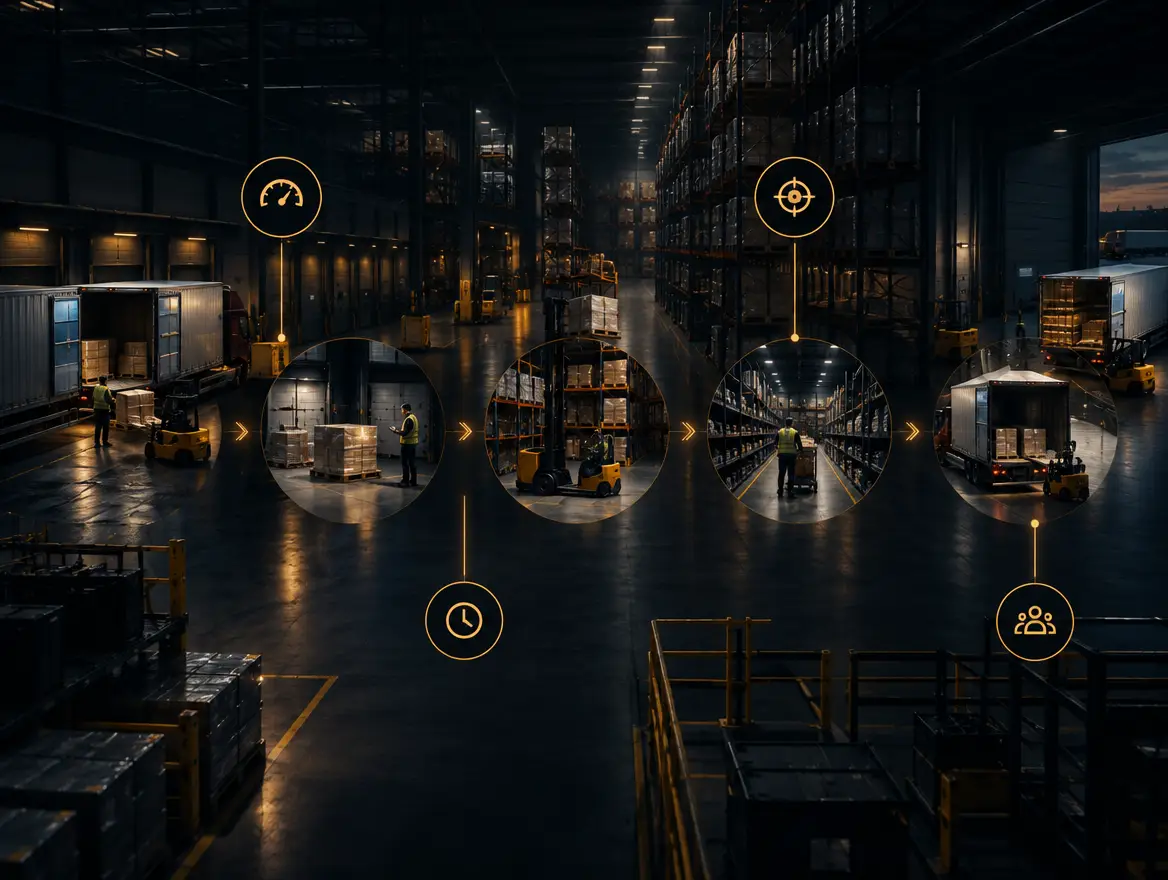
Define success as operational KPIs before you sign, and write them into the contract as agreed measures. The core four are throughput, accuracy, dock-to-stock time and user adoption. Set a baseline from your current site first, agree how each is measured, and decide who owns the number at go-live and after.
The four measures that matter
- Throughput: the volume your site can move per shift on the new system, at normal staffing and without extra overtime. Measure inbound and outbound separately.
- Accuracy: inventory accuracy and order or loading accuracy. Include stock differences between the system and the physical floor.
- Dock-to-stock: the time from a delivery arriving at the dock to stock being available in the system and ready to pick.
- User adoption: whether operators use the system as designed. Track scan compliance, volume of manual workarounds, exceptions resolved without supervisor intervention, and how confident pickers and supervisors say they feel.
Baseline first, targets second
You cannot agree a target without a starting point. Measure your current site before the contract is signed, using the same definitions you will use after go-live. If your current numbers are unreliable, that is itself a finding, and one reason to get an independent view early.
Do not copy targets from industry decks. Your product mix, handling units and labour model are specific to you. A target that suits a high-velocity FMCG DC may be wrong for a pharma cold chain site with strict batch and temperature controls.
Tie acceptance and payment to outcomes
The cleanest way to align a partner to your result is to link acceptance milestones to operational performance, not document delivery. That does not mean the partner carries all the risk. It means hypercare exit, final milestone payments or both depend on agreed KPIs being met under normal operating conditions.
This is what we mean by outcome rather than budget focused. Budget discipline matters, and Luminar's own record is 100% of projects delivered on time and in budget across three projects in 12 months. That is Luminar's own track record, from a small sample, and not an industry benchmark. But a project delivered on budget that leaves operators working around the system has not delivered value. Outcome-focused buyers get more from EWM because they hold partners to measurable operational performance rather than to a list of documents.
Make adoption measurable
Adoption is the KPI buyers most often leave out because it feels soft. It is not. Pickers and supervisors gain confidence in a system that is easy to use and predictable. They lose it when screens behave inconsistently or when every exception needs a phone call. Agree how you will observe adoption in the first weeks, who will do the observing, and what triggers extra support. Being user focused rather than system focused is a design principle, and it should show up as a measure.
Where an Independent Senior View Fits Alongside Any Integrator
An independent senior view fits alongside the integrator as a check on scope, design and readiness. It does not replace the integrator. An independent adviser sells no software and does not sell the build, so the only interest is whether the warehouse works. It is most useful before signing and at the points where pressure to hit dates is highest.
What an independent adviser does
The role is practical. Before contract, review the proposal for artefact-heavy scope, thin staffing and vague KPIs. During design, challenge choices that add scans and system steps without a floor reason. During testing, bring operators into the process and check the scenarios reflect real work. Before go-live, give the sponsor an honest read on operational readiness, separate from the project's own status reporting.
For live EWM sites, the same independence applies in a different form. An EWM health check looks at where drift has crept in and what is worth fixing, without a pitch to rebuild the site.
Why independence matters
Integrators are paid to deliver the scope. That is a fair commercial arrangement, but it means they are rarely the party best placed to say the scope is wrong. An adviser with no stake in the build can say it. The same applies to EWM vendor selection: an independent view helps you compare partners on floor experience and staffing, not on presentation.
The honest caveats
An independent adviser adds cost and another voice to the project, and it only works when the sponsor gives them real access to the site and the team. For a small, simple site with an experienced integrator, you may not need one. Many integrators run excellent programmes. The case is strongest when the stakes are high, the timeline is tight, the scope is complex, or when you are not an SAP specialist and still have to sign for the result.
What a Plasterboard DC Taught Us About User Confidence
User confidence, not configuration, determined go-live success at a Brisbane plasterboard manufacturing and distribution site where Johan Bruwer's team supported an SAP EWM rollout. The business had run its warehouse on a non-warehouse-management base, with delayed inventory updates, stock inaccuracies and slow reconciliation between manufacturing and physical stock.
The company chose to land its in-house global SAP EWM template. It needed an in-country partner to act as the local conduit between the German build team and local operations. Our initial brief was change management and operational readiness. It grew into full project responsibility.
What we did differently
Several choices mattered more than any single configuration item:
- Fixing the hardware problem early. Using Luminar's partner relationships, we helped replace inadequate hardware with the company's global standard devices and recovered some of the time the project had lost. We also helped internal field service teams achieve a 50% reduction in the cost of the required network due diligence.
- Closing gaps with standard functionality. During build, we identified gaps in goods receipt from manufacturing and in shipping, then solved them using standard SAP EWM functionality. The solutions simplified the Australian rollout and were adopted into the global template for future sites.
- Keeping UAT confidence high. We supported user acceptance testing with high availability and quick error resolution, so that testers saw problems fixed fast and trusted the system.
- Training key users on real scenarios. Working with global process owners, we trained key users using real scenarios and pragmatic fault-finding. They passed that knowledge to the wider user community with confidence.
- Configuring devices for the task. We set up the Getac and Zebra devices to simplify mobile data entry and scanning, because every extra tap costs time on the floor.
- Staying close at go-live. We fixed errors quickly to reduce rework and downtime.
The outcome
These are Luminar's results from this site, not a guarantee for yours. The transition from the legacy approach to SAP EWM was seamless for the operation. On some days the site processed up to 30% more outbound volume with no additional overtime. With nominal system errors, Luminar and the IT team could turn to small improvements in the second week after go-live.
Operations management reported that warehouse activity became traceable, and that loading errors and stock differences improved greatly. Subcontractor drivers arriving on site were positive about the experience. They had seen a competitor going through a similar change and facing severe loading issues that led to demurrage costs. The global process owners described the rollout as the most successful one so far.
The lesson for buyers: nothing in that list is an artefact. It is hardware that worked, gaps closed in a way operators could follow, testers who trusted the fixes, and key users who could explain the system to their colleagues. When you evaluate a partner, ask how they will earn that confidence, and how they will prove it.
Book the Complimentary Floor Audit
If you are comparing partners or doubting the one you have, the quickest way to ground the conversation is to see your floor. The Floor Audit is complimentary. A senior Luminar consultant spends one day on site with you, and you receive a plain-language memo within five working days. No proposal is attached.
If you would rather start with a conversation, book a 30 minute advisory call instead. Either way, you get an independent senior view from a consultancy that sells no software and does not sell the build.
References
- SAP, SAP Extended Warehouse Management documentation on SAP Help Portal
- SAP, Roadmap Viewer for SAP Activate implementation methodology
- GS1 Australia, Standards and barcoding guidance for supply chains
Luminar's delivery record (100% of three projects delivered on time and in budget over 12 months) and the plasterboard site outcomes are Luminar's own data and experience.
One day on your floor, a plain-language memo in five working days.
A senior SAP EWM consultant watches the busy window, reads the system alongside it and tells you what is costing taps, seconds and dollars. No proposal attached.