

One sentence first. SAP EWM is the system that tells every person and machine in the warehouse what to do next, down to the bin and the pallet, and records what they did as they do it. SAP inventory management, which most SAP businesses already run, knows what you own and roughly where it is. EWM runs the building. The difference between those two ideas is the subject of inventory management is not a WMS, and it is where most of the labour, accuracy and damage costs in a warehouse sit.
A pallet's day, in EWM.
At the dock.
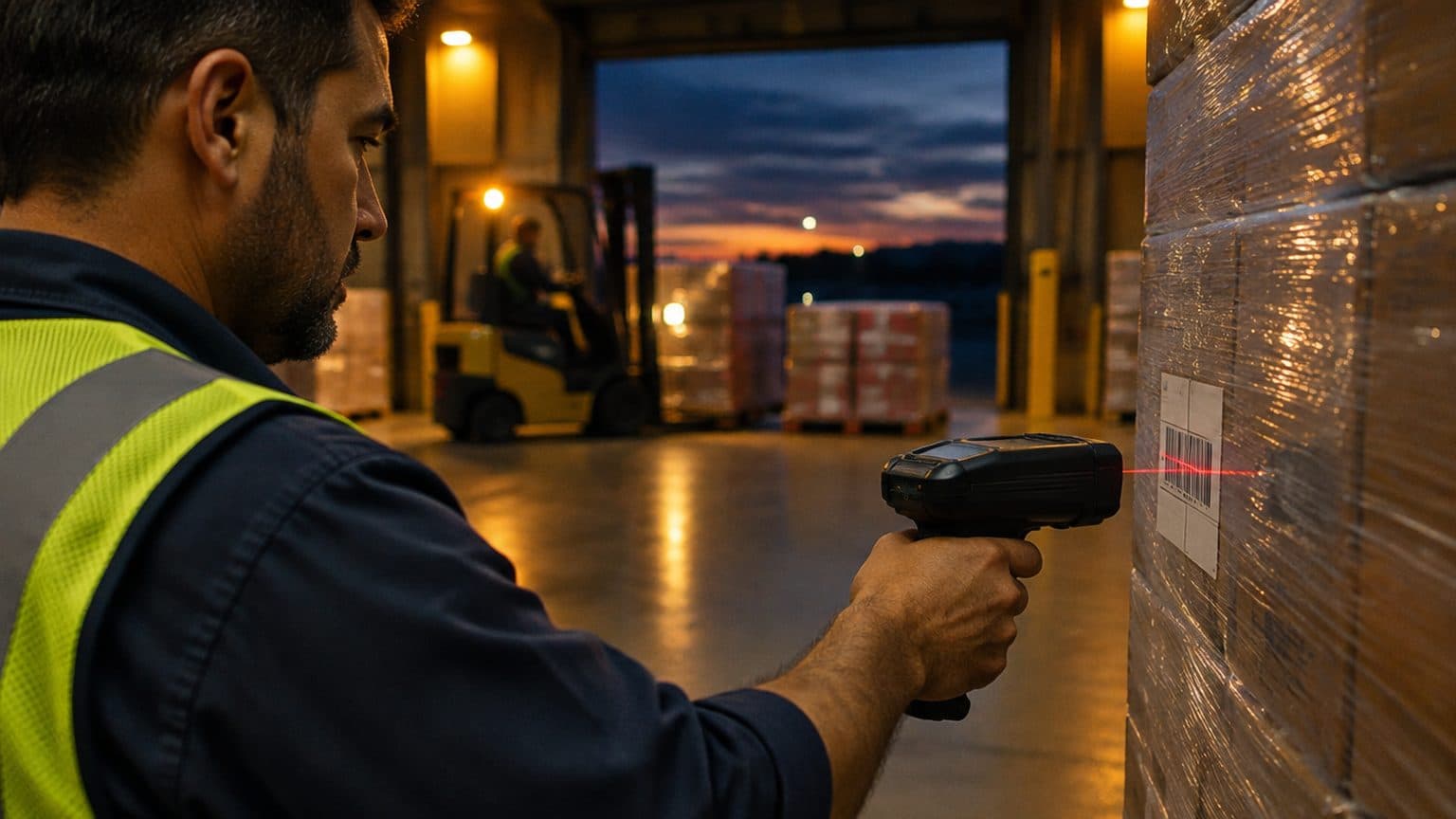
A truck arrives against an inbound delivery the system already expects. The operator scans the label on each pallet, which EWM treats as a handling unit: a thing with its own identity, contents and history, not just a quantity of a material. If the goods need inspection, EWM holds them and tells quality what to check. Anything that does not match the delivery is recorded at the door, where it is cheapest to fix.
Into storage.
EWM creates a task to put the pallet away and proposes the bin, using rules the business set when the system was designed: which storage area suits this product, which bins have room, what should sit near the pick face. The operator drives to the bin and scans it to confirm. Until that scan, the system does not believe the pallet has moved, which is the point. The quality of those rules depends on the product master data behind them: dimensions, weights, units of measure and packaging.
Out to the customer.
Orders from the ERP become outbound work. EWM breaks them into picking tasks, groups those tasks into orders a single person or device can work through, and sequences them along a sensible path. The picker sees one instruction at a time on a scanner: go here, take this many, scan to confirm. Packing, staging at the dock and loading follow the same pattern, and when the truck leaves, EWM posts the goods issue back to the ERP so finance and customer service see it straight away. How those screens are designed decides how fast the floor can work, which is why the RF flow is the product.
Counted, and corrected.
Stock is counted by bin, on a schedule or when something looks wrong, and differences are recorded and cleared through a controlled process rather than quietly adjusted. When a picker finds a bin short or a carton damaged, they report it on the scanner with an exception, and the system decides what happens next. Where those exceptions are avoided instead of used, the stock record drifts, as stock accuracy after go-live sets out.
What the supervisor sees.
The warehouse monitor is the supervisor's view of the building: open tasks, backlogs by area, which resources are working on what, deliveries at risk, and exceptions waiting for someone to act. A good monitor setup means the first hour of a shift is spent moving people to where the work is, instead of walking the floor to find out.
What it connects to.
The ERP, first: purchasing, sales, production and finance all see what the warehouse does as it happens. EWM can run inside the S/4HANA system or on its own system beside it, a choice set out in embedded or decentralised EWM. Beyond the ERP it connects to quality, transportation and production supply, to label printers and scanners, and to automation. Basic EWM talks to conveyors and shuttles through an interface to the equipment supplier's own control system. Advanced EWM can drive that equipment directly.
Basic, advanced, and the option before both.
Basic EWM sits in the S/4HANA core under the Enterprise Management licence and covers the day described above. Advanced EWM is licensed separately and adds direct automation control, waves, labour management, yard, cross docking, value-added services and more. Below both sits Stock Room Management, the lighter continuation of classic SAP WM for small, simple sites. The dividing lines are in basic or advanced EWM and Stock Room Management or EWM. Exact scope varies by release and contract.
What it does not do.
It does not fix a process that was wrong before it was configured. It will run a bad pick path faster, and it will enforce a confusing screen on every shift. It does not design the building: racking, dock doors and automation are decided by the layout team, and the system has to be designed with them, not after them. It does not make master data accurate; it relies on it. And it cannot work on a floor that cannot scan, which is the lesson in when the floor cannot scan.
EWM does not run your warehouse well. It runs your warehouse exactly as designed, which is why the design has to start on the floor.
When a business needs it.
The signs are familiar: stock reconciliation that takes weeks, bin locations carried in a few people's heads, a spreadsheet next to every scanner, damage and service figures sliding as volume grows. Which form of warehouse system fits is a separate question, set out in choosing a warehouse system when SAP is your ERP.
From there the work depends on where you stand: a new distribution centre, a move off SAP WM, a global template landing on an Australian site, a go-live that is already scheduled, or a live system that has drifted.