

A good SAP EWM RFP describes how your warehouse runs, shift by shift, then makes every integrator price the same scope as separate line items: testing, data migration, hardware, key user backfill, cutover and hypercare. Add a named staffing matrix and an outcome-weighted scoring grid, and proposals become directly comparable.
Most SAP EWM RFPs fail before a single response arrives. They hand integrators a feature catalogue, and each integrator prices the project it imagines. When the proposals land, the numbers cannot be compared, so the decision defaults to the lowest price or the most comfortable presentation.
This guide is about the document itself. We are an independent consultancy, and Luminar does not sell the build, so we have no stake in which integrator wins. You will get a structure for writing the RFP around your floor, the line items to force into the open, a staffing matrix, a scoring grid and a list of red flags. Once the proposals are in, the next step is how to interview an SAP EWM integrator.
Key Takeaways
- A feature-list RFP invites every integrator to fill the gaps with its own assumptions, so each proposal prices a different project.
- Describe a day on your floor in sequence, then list the SAP functions each step depends on. Integrators then price a workflow, not a catalogue.
- Make testing, data migration, hardware, key user backfill, cutover and hypercare separate line items with stated assumptions.
- Ask for a named role matrix with days per phase, onshore and offshore split, hands-on EWM years and substitution rules.
- Score on operational outcomes and readiness, not artefact counts, and fix your weights before proposals arrive.
- Hypercare is the most common place where a cheaper proposal quietly excludes scope.
Summary Table
| RFP element | What to put in the document | What it prevents |
|---|---|---|
| Floor narrative | A shift-by-shift description of how work moves | Integrators pricing a generic feature set |
| SAP dependency map | ERP, transport, MHE and label needs per floor step | Hidden interface and integration scope |
| Separate line items | Testing, data, hardware, backfill, cutover, hypercare | Bundled prices that bury exclusions |
| Role matrix | Named people, days per phase, location, experience | Junior-heavy teams at senior-looking rates |
| Response template | Fixed sections, mandatory assumptions and exclusions | Responses that cannot be laid side by side |
| Scoring grid | Outcome-weighted criteria agreed before release | Decisions driven by price or presentation polish |
Why do feature-list RFPs produce proposals you cannot compare?
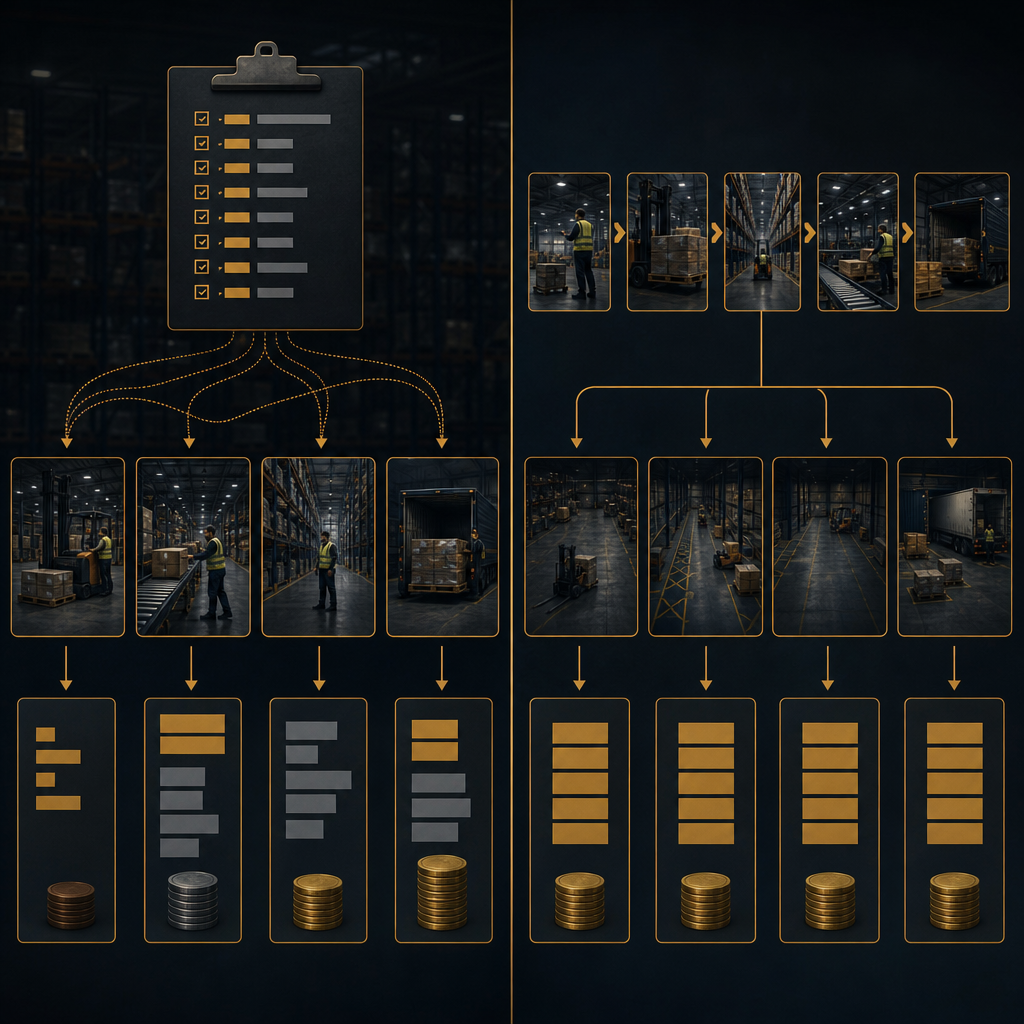
Feature-list RFPs ask integrators to confirm SAP EWM capabilities, not to price a defined outcome. Each integrator fills the gaps with its own assumptions about scope, testing, data and support. The price differences you then see reflect assumptions, not value, so the comparison is meaningless.
A typical catalogue RFP lists wave management, slotting, yard management, labour management, cross-docking and so on. Every integrator answers 'yes' to every line, because EWM can do all of it. That answer tells you nothing about what you will actually get on your floor.
Three things follow.
Scope hides in assumptions. One response assumes two test cycles, another assumes four. One assumes you cleanse your own master data. One includes printers and another does not. None of this is visible in the headline price.
Artefact counts replace outcomes. Without a floor description, integrators fall back on what they can count: workshops, blueprint documents, test scripts. These look like progress. They do not tell you whether a picker will find the next task predictable at six in the morning.
Risk moves to you. Every unstated item becomes a change request later. The buyer signed for an outcome and ends up funding the gaps.
Our view, shaped by Johan Bruwer's 15+ years across SAP WM and EWM programmes, is that budget certainty starts at the RFP, not in the contract negotiation. Luminar has delivered 3 projects in the last 12 months, 100% of them on time and in budget (Luminar's own data). Three projects is a small sample and we do not claim it proves a law. But the common thread is that scope was described in operational terms before anyone priced it.
If you are moving off SAP WM, the problem is sharper. EWM is not a like-for-like upgrade, so a feature list copied from your current setup describes the old design, not the one you need. Our page on SAP warehouse management covers that move in more detail.
How do you write the RFP around your floor, shift by shift?

Describe one representative day in sequence: inbound, putaway, replenishment, picking, packing and dispatch, plus cold chain or dangerous goods handling where relevant. For each step, state volumes, peaks, handling units and exceptions, then list the SAP functions the step depends on. Integrators then price a workflow, not a catalogue.
Write the day, not the feature
Work through the floor as your supervisors would explain it to a new starter. Break it into shifts, because the floor behaves differently across them. The early shift might be dominated by inbound unloading and putaway. The afternoon might be a picking and packing peak against a carrier cut-off. The night shift might run with a smaller crew and fewer supervisors.
For each step, capture five things:
- Who does it, and how many people at peak.
- What device they use: RF handheld, vehicle-mounted terminal, pick-to-light, voice.
- What triggers it: an inbound delivery, a replenishment task, a wave, a carrier booking.
- What the unit of work is: pallet, carton, each, mixed pallet, handling unit.
- What goes wrong: short deliveries, damaged stock, wrong labels, blocked locations, late trucks.
The fifth item matters most. Exceptions are where systems either earn trust or lose it, and they are the part feature lists never describe.
Map each step to the SAP functions it depends on
Once the floor is written down, list what each step needs from the wider landscape. The SAP Help Portal documentation for SAP Extended Warehouse Management is a useful reference for the standard functions involved, but your RFP should state dependencies in your own terms.
| Floor step | What to describe | SAP and landscape dependencies to name |
|---|---|---|
| Inbound | Delivery types, unloading method, inspection needs | ERP purchase orders and deliveries, advance shipping notices, dock scheduling |
| Putaway | Storage types, mixed pallets, bulk versus pick faces | Putaway rules, handling unit management, label printing |
| Replenishment | Triggers, urgency, who moves what | Min and max or demand-based rules, MHE interfaces if automated |
| Picking | Pick method, batching, zone handoffs | Wave or order-based release, RF screens, labour rules |
| Packing | Pack stations, cartonisation, scale checks | Packaging specifications, shipping label and document printing |
| Dispatch | Carrier cut-offs, loading sequence, proof of load | Transport integration, goods issue back to ERP, load verification |
This table becomes an appendix to the RFP. It shows integrators exactly which interfaces, devices and labels sit inside scope, so none of them can price a narrower project and look cheaper.
Cold chain and dangerous goods
If you handle temperature-controlled or dangerous goods, say so at the step where it applies, not in a compliance annex. State the temperature zones, the batch and expiry rules, and any segregation requirements. For dangerous goods, name the obligations that apply to you under the Australian Dangerous Goods Code, and ask integrators how the system enforces them at the RF step rather than relying on operator memory.
Predictability is what builds user confidence
User confidence does not come from a long feature list. It comes from ease of use and predictability. For every system action there is a physical movement on the floor, and every extra scan or screen step adds labour, delay and frustration. That is where cost compounds.
We call the gap between design and practice System Vs Reality. A design might expect operators to follow rigid sequential steps, such as unpack, inspect, then putaway, without deviation. Real workers combine steps, skip exceptions and meet handling units nobody planned for. If the RF screens do not handle that intuitively, workers abandon the system or work around it.
Put this into the RFP as a requirement. Ask each integrator to describe, in floor terms, how the proposed design handles a mixed pallet, a damaged carton and a short delivery. A team that has stood on a dock will answer in a few lines. A team that has not will answer with a feature name.
Which items should every integrator price as separate line items?
Make integrators price testing cycles, data migration and cleansing, RF hardware and printers, key user backfill and training, cutover, and hypercare as separate lines, each with stated assumptions. Anything bundled as 'included' is where scope quietly disappears and where change requests later appear.
| Line item | What to force into the open | Common hidden assumption |
|---|---|---|
| Testing cycles | Cycle types, who writes and runs scripts, defect turnaround | Fewer cycles than your risk needs |
| Data migration and cleansing | Objects in scope, mock loads, reconciliation | Buyer cleanses and loads their own data |
| RF hardware and printers | Devices, printers, network readiness, configuration | Hardware and Wi-Fi are the buyer's problem |
| Key user backfill and training | Key user time per phase, training method, materials | Backfill cost sits outside the proposal |
| Cutover | Rehearsals, stock take, freeze window, rollback criteria | One cutover attempt with minimal on-site support |
| Hypercare | Duration, staffing, response times, exit criteria | Optional, or billed on time and materials |
Testing cycles
Specify the structure you expect: integration testing across ERP, EWM and any equipment, user acceptance testing with real floor scenarios, and a volume test at realistic peak. Then ask each integrator to state how many cycles they have priced, who writes scripts, who executes them, and how fast defects are resolved. The number of cycles is theirs to declare. The structure is yours to set.
Data migration and cleansing
EWM depends on clean product data: dimensions, weights, packaging specifications, storage attributes. Ask who cleanses, who loads, how many mock loads are included and how reconciliation is signed off. Poor data is one of the most common reasons a technically sound build behaves badly on go-live day.
RF hardware, printers and network
Hardware is often left as an assumption. State whether you expect the integrator to specify, supply and configure handhelds, vehicle terminals and label printers, or whether you will procure them. Include network readiness in the same line. In Johan Bruwer's experience on a Brisbane building materials rollout, replacing inadequate hardware with the client's global standard devices and arranging the network due diligence through partner relationships cut the cost of that due diligence by 50% (Luminar's own project data). It was a line nobody had scoped properly at the start.
Key user backfill and training
Key users are your people, and their time is a real cost. Ask each integrator to state key user days per phase so you can budget backfill. Ask how training is delivered. Training built on real scenarios and practical fault-finding lets key users pass knowledge on with confidence. Slide decks do not.
Cutover
Ask for the number of rehearsals, the stock take approach, the freeze window, the rollback criteria and the on-site support roster for the first shifts. Cutover is a floor event, not a technical event, and the proposal should read that way.
Hypercare: duration and exit criteria
Hypercare is where cheaper proposals most often leave a gap. Require a stated duration, a named team, response times by severity and, critically, exit criteria. Exit criteria should be operational: no open priority incidents, key users resolving first-line queries themselves, and agreed floor measures such as dock-to-stock time and pick accuracy holding steady.
Here is an illustrative example of a pattern Johan Bruwer has seen across 15+ years. Two integrators respond to the same RFP for a comparable site. One proposal is materially cheaper, and the executive sponsor is drawn to it. A closer read shows the cheaper proposal excludes hypercare from the fixed price and lists post go-live support 'available on request' at time and materials rates, in an appendix. The other proposal includes a defined hypercare period with exit criteria in the headline price. Once hypercare is priced into both, the gap largely closes, and the buyer realises the cheaper option left them with no cap on the most uncertain weeks of the programme. The numbers differed because the scope differed, not because one integrator was more efficient.
How do you make staffing and seniority comparable?
Require a named role matrix: each role, the person, days per phase, onshore and offshore split, years of hands-on EWM experience and substitution rules. Without it, a blended rate hides who actually does the work, and you cannot tell a senior-led team from a junior one priced the same.
| Matrix field | Why it matters | What to watch for |
|---|---|---|
| Named person per role | You are buying people, not a brand | 'To be confirmed' on lead roles |
| Days per phase | Shows where senior time is actually spent | Senior days only in the pitch and design phases |
| Onshore and offshore split | Affects overlap with your shifts and cutover support | Offshore work on floor-facing tasks without local cover |
| Hands-on EWM experience | Separates EWM delivery from general SAP experience | Years counted at the employer, not in the role |
| Substitution rules | Protects continuity when people move | No notice period, no handover at the integrator's cost |
A few practical points.
Ask for hands-on experience by role. A solution architect with years of EWM go-lives is different from one whose experience is mostly ERP. Ask for CVs showing the specific EWM go-lives where each named person held that role.
Define offshore clearly. State which work can be delivered remotely and which must be on site, such as UAT support, cutover and the first shifts after go-live. Ask what time zone overlap the offshore team provides with your operating hours.
Lock the key roles. Require written approval for substitution of named lead roles, a handover period at the integrator's cost, and a replacement of equal or greater experience.
Ask for the rate card and the total. The rate card lets you price change fairly. The total, built from days by role, lets you check the maths against the headline price.
What should a response template and scoring grid look like?
Issue a fixed response template so every integrator answers the same questions in the same order, then score against measurable operational outcomes. Weight floor fit, scope completeness, team strength and hypercare exit criteria above artefact counts such as workshops held or documents produced.
The response template
Give integrators a structure they must follow. A workable order is:
- Their understanding of your floor, written back to you in shift terms.
- The proposed solution for each floor step, including exception handling on RF.
- Assumptions and exclusions, as a mandatory section with no appendix hiding.
- Pricing by the separate line items above, with fixed, capped and time and materials amounts clearly distinguished.
- The named role matrix.
- The plan, with phase gates tied to operational readiness, not only dates.
- Key risks and how each will be managed.
- How they will prove outcomes at go-live and at hypercare exit.
The assumptions and exclusions section is the most valuable page you will receive. Make it mandatory and make 'none' an unacceptable answer.
Readiness gates over calendar gates
Most implementations push to strict timelines, forcing operations to change before they are properly set up and enabled. Our position is that blindly progressing through phases weakens how well stakeholders absorb the system, lowers solution quality and widens project gaps. Ask integrators how they would hold a gate if the floor is not ready. An integrator that cannot answer is selling a date, not an outcome.
The scoring grid
Set your weights before any proposal arrives and do not change them afterwards. Use numeric weights that suit your organisation. The qualitative ranking below shows the order we recommend.
| Criterion | What good looks like | Relative weight |
|---|---|---|
| Floor fit | Walks one shift end to end in your terms, including exceptions | Highest |
| Scope completeness | Every line item priced, assumptions and exclusions explicit | Highest |
| Team strength and continuity | Named seniors with hands-on EWM, clear substitution rules | High |
| Operational readiness and hypercare | Readiness gates, operational exit criteria, staffed hypercare | High |
| Plan realism | Cutover rehearsals, testing depth, key user time acknowledged | Medium |
| Commercial clarity | Fixed and variable amounts separated, change rate card supplied | Medium |
| Presentation and artefacts | Tidy documents and tooling | Low |
This is what we mean by being Outcome rather than Budget focused. The lowest price scores on one line only. Operational outcomes score on most of them. Once your scoring is done, the shortlist moves into interviews, which we cover in how to interview an SAP EWM integrator.
What red flags show up in returned proposals?
The main red flags are bundled prices, vague assumptions, exclusions buried in appendices, hypercare 'as required', unnamed teams, and a plan driven by calendar dates rather than readiness. Any one can be clarified. Several together suggest the quoted price will not hold.
- 'Standard' or 'fully compliant' against every line. EWM can do a great deal. An answer that never discusses how it should be configured for your floor is a catalogue reply.
- No floor language. If the proposal never mentions your docks, shifts, pack stations or exceptions, it was written from a template.
- Hypercare undefined or optional. No duration, no exit criteria, or support offered at time and materials only.
- Data migration marked as client responsibility with no detail on mock loads, tooling or reconciliation.
- Hardware and network assumed away. Devices, printers and Wi-Fi readiness left to you without a line item.
- Unnamed or 'to be confirmed' leads. Senior names appear in the pitch but not in the days-by-role matrix.
- Heavy offshore share with no floor-facing cover. Nobody senior on site for UAT, cutover or the first shifts.
- Extra scans and steps designed in without a reason. Each added step is a physical movement your people repeat all day. This is System Vs Reality in practice.
- Artefact counts as the main evidence. Numbers of workshops and documents, with no measurable floor outcome attached.
- A plan that never pauses. Fixed dates with no readiness gates or conditions for holding a phase.
When you spot these, send a written clarification round to every integrator with the same questions. That keeps the field level and often exposes the real scope.
What a floor-first scope looks like in practice: a Brisbane go-live
This is a first-hand example from Johan Bruwer's work, with the client anonymised. A Brisbane-based building materials manufacturer and distributor was running its warehouse without a warehouse management system. Inventory updates were delayed, stock was inaccurate, reconciling manufacturing with physical stock was complex, and sales lead times to customers were longer than they should have been.
Supply chain leadership chose to roll out the company's own in-house global SAP EWM template. The project needed an in-country partner to act as the local conduit between the German build team and Australian operations. Luminar was engaged for change management and operational readiness, and the role grew into full project responsibility.
The work that mattered most is the work a feature-list RFP rarely prices:
- Inadequate hardware was replaced with the global standard devices, and the network due diligence cost fell by 50% through partner relationships.
- Gaps found in the build were solved with standard EWM functionality for goods receipt from manufacturing and for shipping. The solutions simplified the Australian go-live and were adopted into the global template.
- UAT was supported with high availability and fast error resolution, which kept confidence in the solution high.
- Key users were trained on real scenarios with practical fault-finding, so knowledge passed to the wider user community with confidence.
- Handheld and scanner devices were configured to simplify mobile data entry.
- Go-live support focused on quick error resolution to limit rework and downtime.
The outcomes, reported from Luminar's own project experience, were a smooth move from the legacy setup, outbound volumes some days up to 30% higher with no additional overtime, and so few system errors that the team turned to small improvements in the second week. Subcontractor drivers noticed the difference, having seen a competitor going through a similar change and facing severe loading problems that led to demurrage costs. Operational management reported better traceability and fewer loading errors and stock differences. The global process owners called it their most successful rollout so far.
Three lessons carry into your RFP. First, hardware, network, key user training, UAT responsiveness and go-live support decided the result, so they must be separate, priced lines. Second, the design was User focused rather than System Focused: the solutions followed how the floor worked. Third, readiness, not the calendar, kept the Implementation on Track.
A caveat: this was a template rollout with a global build team, so a greenfield RFP has more design scope. The principle holds either way. Describe the floor, price the enablers, and measure the outcome on the dock.
What should you do before the RFP goes to market?
Before release, attach a plain-language baseline of your floor, run your draft past someone with no stake in the result, and fix your scoring weights. An independent review costs little compared with the cost of comparing proposals that price different projects.
Two ways we can help, neither of which comes with a sales pitch for the build:
- Book a 30 minute advisory call to review a draft RFP. We will test the floor narrative, line items, role matrix and scoring grid.
- Request the complimentary Floor Audit. A senior consultant spends one day on site and you receive a plain-language memo within five working days, with no proposal attached. It gives you a floor baseline to attach to the RFP before it goes out.
Luminar sells no software and does not sell the build. See our warehouse management consultant services for how we work with greenfield builds, moves off SAP WM, global template rollouts and live EWM sites that have drifted.
References
- SAP, SAP Extended Warehouse Management documentation (SAP Help Portal)
- National Transport Commission, Australian Dangerous Goods Code
- SAP, SAP Activate Roadmap Viewer
One day on your floor, a plain-language memo in five working days.
A senior SAP EWM consultant watches the busy window, reads the system alongside it and tells you what is costing taps, seconds and dollars. No proposal attached.