
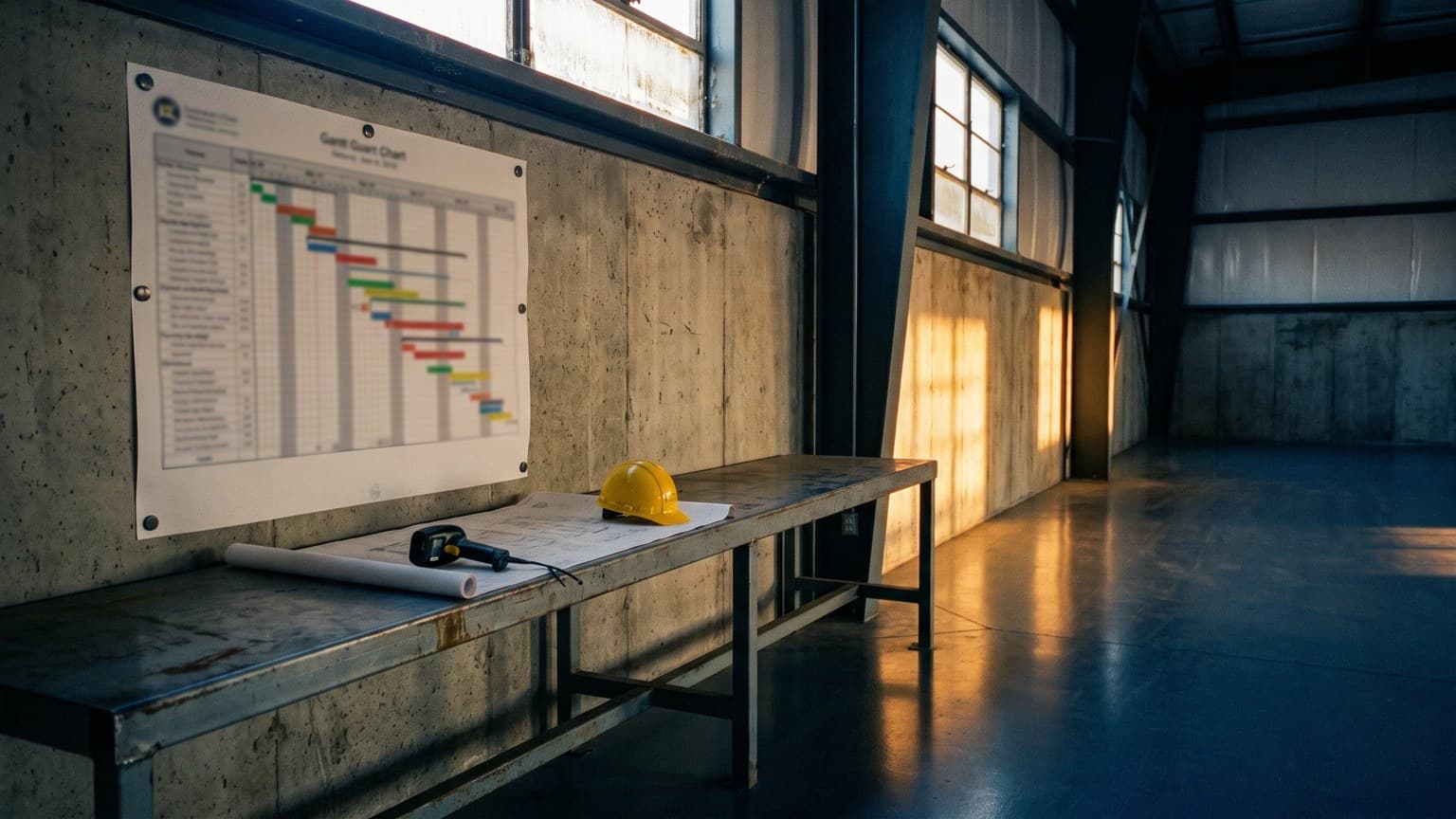
The integrator's plan will give you a number of months. Treat it as a statement about how long configuration takes when nothing else gets in the way, because that is what it is. On a greenfield site the calendar is set by decisions, data and a building, in that order, and the software is waiting on all three. The plan that survives contact with the floor is the one that says what each phase is waiting for, not just how long it lasts.
The phases, and what each is really waiting on.
Design.
The operating model and the process design: how goods arrive, wait, move, pick and leave. On a greenfield site this phase is waiting on decisions, and the decisions are waiting on people who have the authority to make them and the time to attend. It runs fast when the business has a named process owner in the room. It runs forever when every workshop ends with "we will take that back".
Build.
Configuration of standard EWM, plus whatever custom development the design phase agreed to. This is the part the plan is usually right about, provided the design is closed. Every design decision reopened during build is a week added, and it is rarely just one.
Data.
Not a phase on most plans, which is the problem. Master data for a warehouse that does not exist yet has to be created from drawings and then verified against steel. It runs alongside build and it is waiting on the racking layout being final, on product dimensions being measured rather than guessed, and on someone owning the answer.
Test.
Integration testing, then user acceptance on the floor with the people who will run it. Waiting on the data being loaded and the building being far enough along to test in. A test phase that starts before either is a test phase that gets repeated.
Readiness and cutover.
Training on real scenarios, the readiness gate, the rehearsed cutover, the first stock arriving. Waiting on the building being handed over, the hardware being installed and networked, and the supervisors having run a shift end to end on the system.
Hypercare.
Long enough to see the operation settle into its real rhythm, which on a new site means long enough to see a full cycle of the volumes the business actually planned for.
The three things that stretch it.
Design that keeps moving.
The single biggest cause of a long build is a design that was never closed. It looks closed. There is a signed document. But the people who signed it were not the people who run the floor, and when the floor people see the build they start changing it. The fix is not a stricter change process. It is having the right people in design in the first place, and designing from the RF flow the operator will hold rather than from a process diagram they will never see.
Data nobody owns.
The integrator builds the structures. The business is asked to fill them. Nobody is named as the person who signs off that a pallet of this product fits a bin of that type. The gap surfaces in test, or worse in the first week live, and the calendar absorbs it.
The building and the system on different clocks.
Greenfield sites have a construction programme and a system programme, and they are run by different people who rarely sit in the same meeting. When the racking slips six weeks, the data slips six weeks, the test slips six weeks, and the go-live date the business told its customers does not move at all. We have written separately about running the two clocks together in Standing up EWM alongside the building.
A greenfield EWM build is a series of things waiting on other things. The plan that tells you what each phase is waiting for is worth more than the one that tells you how long it lasts.
How Luminar approaches the calendar.
We do not run the build, so we have no interest in a plan that looks short. Our job is to shape the programme before delivery: to get the design closed by the people who will live with it, to set master data ownership before anyone opens a configuration screen, and to put the construction programme and the system programme on one page so the dependencies are visible to the person signing for the outcome. A single-site build with those three in hand runs in months. The ones that run in years are the ones where all three were left to sort themselves out.